Choosing the Right AI Strategist: What Companies Get Wrong
Most companies don't get burned by choosing the wrong AI tools. They get burned by choosing the wrong AI strategist.
That distinction matters more than most executives realize when they're deep in the evaluation process, comparing credentials and sitting through polished demos. The tools conversation is easy — vendors will have it with you all day. The strategist conversation is harder, and most companies aren't asking the right questions.
Here's what the market actually looks like right now: it's flooded with people who can demo a workflow, string together a stack, and talk confidently about transformation. That skill is not rare. What's rare — and genuinely harder to fake — is someone who has both: deep enough technical credibility to earn trust with engineering and data teams, and the organizational instincts to diagnose why adoption fails, why governance doesn't hold, why a pilot that worked in the lab dies in the field.
Those are two different capabilities. Most people have one. You need both.
So what should you actually look for?
The first signal is how they frame the problem
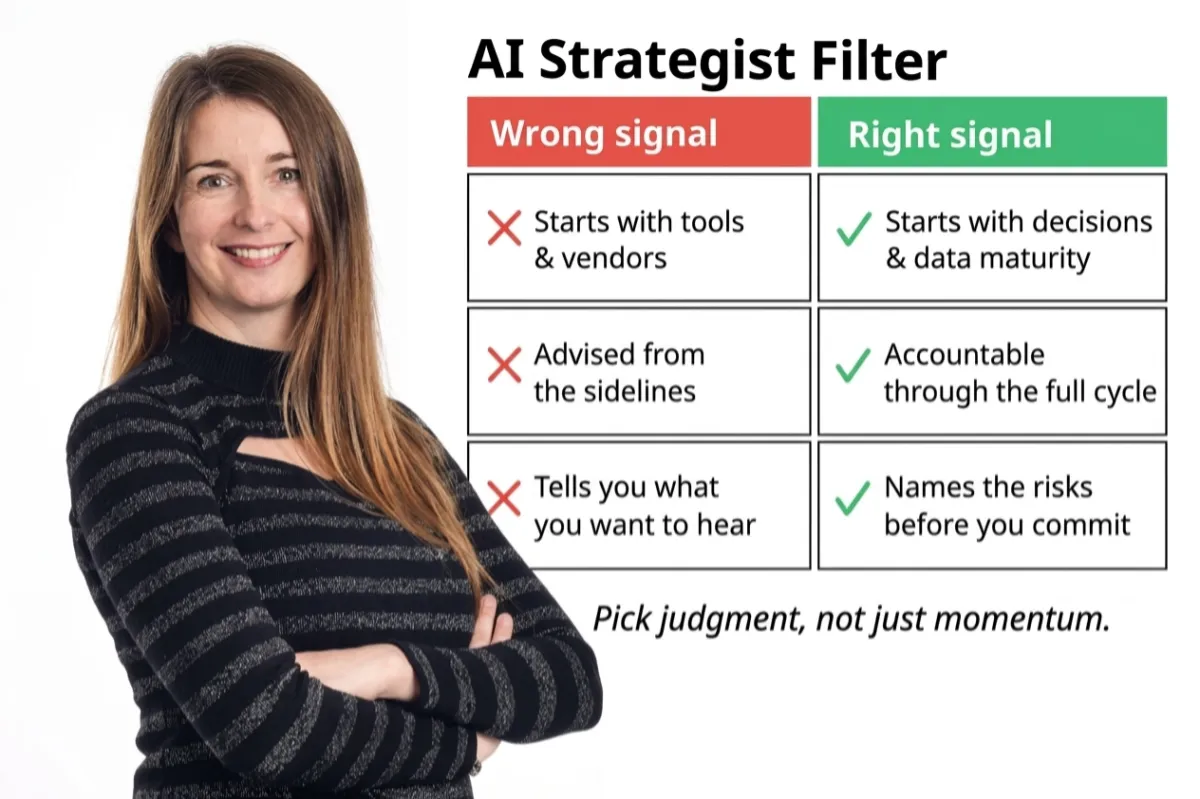
Pay attention to what dominates the opening conversation. If it's tools, vendors, and use cases within the first thirty minutes, that's a signal — and not a good one. A strategist who leads with solutions hasn't yet understood your problem.
Real AI strategy starts upstream: with your decision-making architecture, your data maturity, and where operational friction actually lives in your business. Who owns which decisions today? What data exists, who governs it, and how reliable is it? Where are the workflows that are genuinely broken versus the ones that just feel inefficient? These questions are less exciting than a product demo. They're also the only questions that lead to AI that actually scales.
The technology is the last answer, not the first question. Any strategist worth their fee knows this — and structures their engagement accordingly.
The second signal is whether they've carried accountability across a full implementation cycle
Advisory at a distance is easy. Showing up with a framework, delivering recommendations, and moving on before the deployment gets messy is a comfortable position. It's also a useless one.
The people who genuinely understand why AI initiatives stall are the ones who have been present when they do. Who have had to defend model outputs to a skeptical CFO who wants to know why the forecast is different from the analyst's. Who have navigated a change management failure mid-deployment, when the team that piloted the tool is now quietly working around it. Who have had to explain to a board why the pilot didn't scale — and then go back and fix it.
That kind of experience leaves marks. It shapes how someone thinks about risk, sequencing, and what "readiness" actually means before you commit resources. When you're evaluating a strategist, ask directly: where has an initiative you were responsible for gone wrong, and what did you do about it? The answer — and the comfort level with the question — will tell you a great deal.
Look for that kind of scar tissue. It's the most reliable credential in this space.
The third signal — and the one most companies overlook — is whether they'll slow you down when you need to be slowed down
There is enormous pressure in most organizations to show AI momentum. Boards want to see it. Leadership teams feel it. The market rewards the narrative of transformation. All of that pressure flows toward the person advising you, and a strategist who can't hold their position under that pressure isn't protecting your investment — they're protecting the relationship.
The right person will name the governance gaps before you've committed budget, not after. They'll surface the adoption risks when there's still time to design around them. They'll tell you that the use case you're most excited about is the wrong starting point — and explain specifically why, and what to do instead. That's not friction. That's the job.
The strategist who tells you what you want to hear about your AI roadmap is not on your side. The one who makes the conversation harder in the short term is the one who keeps it from becoming a crisis later.
This is not a market where the stakes are low. AI investments are significant, the failure rate is high, and the gap between a pilot that impresses and an initiative that compounds value is almost never about the technology. It's about the judgment of the person guiding the decisions — before, during, and after deployment.
You don't need someone to make AI feel exciting. You need someone to make it work. Choose accordingly.
© Copy Rights | All Rights Reserved | AI Assembly LLC. Contact: [email protected].